
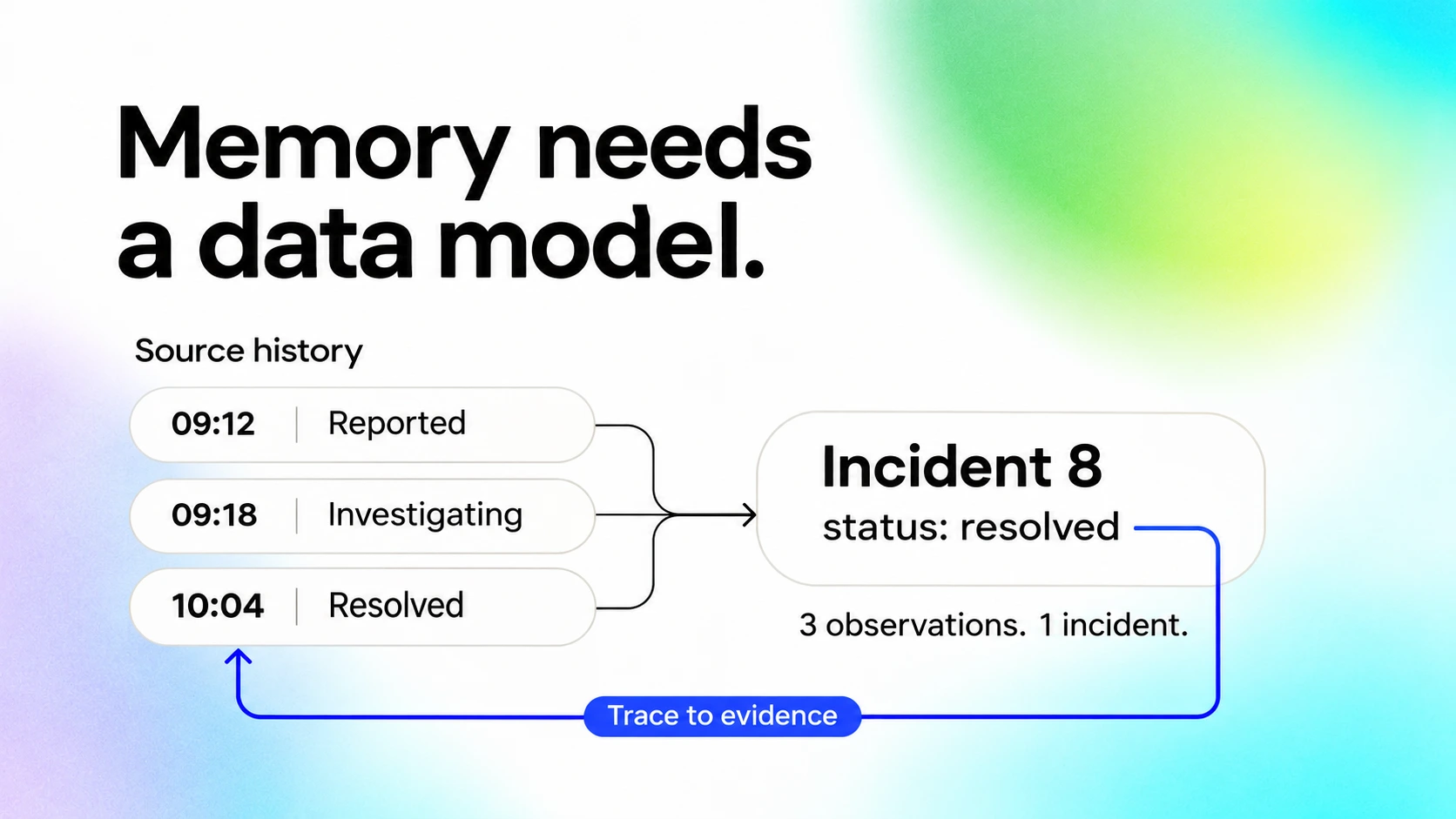
I think memory is a hard standalone business. Two things make it difficult: the model providers control access to much of the conversation history, and capable agents can do a lot with the original data if we give them useful tools.
That changes what I want to build. The durable value is in making data accessible, keeping its history and letting agents organize it for the work a company actually does.
First, you need access to the data
A conversation inside ChatGPT or Claude does not automatically become a source another agent can query. Export and organization access depend on the product, plan and administrator. OpenAI documents self-service exports for eligible accounts, but excludes Business and Enterprise workspaces from that flow. Claude supports exports, with owner-controlled access for Team and Enterprise members.
An archive download is useful. A continuously updated, permission-aware connection is a different requirement. A memory product has to establish access before it can promise to remember anything, and it cannot recover history a provider does not expose.
Second, retrieval is becoming agent work
The original records give an agent options. It can inspect a file, search for an exact identifier, write SQL, or build an index for the current investigation. Reducing everything to a summary or embedding upfront can discard details the next question needs.
For an exact error string, I would start with grep. A semantic question may need vector search. A count needs a defined population and an aggregation. Anthropic describes this kind of agentic context discovery: agents load data as needed, using tools including glob and grep. Exploration has a cost, so precomputed indexes still matter.
Turbopuffer makes the infrastructure point in “RIP, vector database”. Its planned v3 architecture makes the vector index a secondary index alongside other query strategies. It keeps vector search while removing the assumption that every query should revolve around it.
I take a similar lesson for memory. Providing one reliable interface is useful. Expecting one retrieval strategy to answer every question is a much harder promise.
More data creates a history problem
A growing company accumulates conversations, tool calls, source changes and contradictory claims. Finding a relevant paragraph is only part of the job. An operator also needs to know which records supported an answer, what changed afterward and what the agent did about it.
We build Lobu around a connector layer for data sources, search services and execution environments such as sandboxes. Agents can use the appropriate tool while permissions remain in force. Source systems remain authoritative; connection coverage determines what is available.
Alongside that access, Lobu retains conversation and tool-call records and an append-only event log of observations and outputs. Correcting an event means appending a replacement. The old observation remains in history. A summary can help the next agent work, while the underlying evidence remains available for inspection.
We approach memory like a warehouse
A warehouse gives analysts raw observations and a model to work with. They define entities and metrics, transform records, and produce tables other people can query. We apply that pattern to agents.
You define the entities, their fields and relationships, and the metrics you want to calculate. Configure which events belong to which entities and how a measure counts them. Automations do the recurring interpretation: read selected inputs, apply your prompt, and persist declared entity or event outputs. Agents can update entity fields as the evidence changes.
Watch the memory change.
Retained history
3 received- Support report
Northstar reports login failures.
- Engineering update
Login incident is investigating.
- Agent tool call
Read the incident and linked evidence.
- Engineering update
Arrives at a later checkpoint.
Your Automation
Illustrative promptResolve the customer and incident. Maintain its status from engineering updates. Append typed observations with source references.
incident.observed- status
- investigating
- source
- e102
Defined metric
reported_incidentscount(distinct incident_id)Each typed observation refers to Incident #8.
An agent can investigate the result.
Engineering is investigating Northstar’s login failures.
- Incident #8
- Run inputs
- e102
For example, support reports and engineering updates can become a shared Incident record. An Automation maintains its status and emits structured observations associated with the customer. A configured metric counts those observations at a declared grain. The raw inputs and the Automation’s processing history let an agent investigate how that result was produced.
The mapping is explicit work. Every event does not automatically become a correct entity or metric. This is similar to an analyst building a useful data model from messy source records.
Distillation should follow your model
Automatic extraction is useful, and Supermemory already combines indexing, evolving facts, profiles and configurable retrieval. Distillation alone is no competitive distinction.
Our emphasis is on making that work a customizable Automation. You choose the prompt, inputs, trigger and durable output schema. One team can maintain incidents; another can extract research claims. Changing the instructions creates a new Automation version. A typed output can be checked before persistence, while factual correctness still needs evidence.
That structure gives the next agent something to discover. It can inspect a metric definition, query it, follow an entity’s relationships and read the supporting history. It can investigate beyond the first search result.
Our one-question retrieval diagnostic did not establish an accuracy lead over self-hosted Supermemory SuperRAG. The reason to evaluate Lobu is the data work around retrieval: connected access, configurable transformations and a history that lets people and agents inspect the result.
Read next: Ontology, From Tables to Agents. Architecture: Lobu’s data model and metric definitions.